







Persimmons! Diospyros virginiana, Diospyros kaki, and their Hybrids.
Jump to: Site Selection, Site Preparation, Planting, Watering and Fertilizing, Pollination, Choosing A Persimmon Type
SITE SELECTION
Persimmons thrive in full sun, requiring at least six to eight hours of direct sunlight daily
These tree can adapt to a wide range of soil types and are best planted in a pH between 5.5 – 7.5. While they prefer more loam or clay soil, they can still perform well in more sandy locations. Good drainage is critical to prevent root rot.
SITE PREPARATION
Your planting hole should be twice as wide and just as deep as the root ball.
When digging, loosen the topsoil and mix in any soil amendments. You can use this mixture to backfill the Persimmons roots at planting.
Use a gardening fork to break up the sides of your planting hole if they have become smooth from the shovels edge. This helps encourage drainage and prevents eventual root bounding.
PLANTING
No need to soak potted Persimmons prior to planting! Instead, carefully remove your plant from it’s container, gently loosening the roots to encourage outward growth.
Place each plant in the center of the planting hole with its roots down and out. Backfill the hole, using your amended topsoil first. Working the soil carefully around the roots and tamp down gently as you fill the planting site.
Spread soil evenly around the plants and finish with a layer of mulch to assist with water retention and insulation.
WATERING & FERTILIZING
Water well after planting. A deep, slow soak of about 15 minutes will help set the plant, and encourage deep root growth. Water every 2-3 days for the first few weeks, then adjust as needed based on local rainfall, soil types, and temperatures.
We encourage all of our gardening friends to test their soil prior to applying any fertilizers! Persimmons like a well-balanced fertilizer, so we recommend an organic, granular slow release. A 10-10-10 can be used during the growing season, but stop applications around July.
POLLINATION
Persimmons are considered partially self-fertile, but will produce larger crops when planted with a Male pollination companion.
CHOOSING A PERSIMMON TYPE
Persimmons are sorted into two houses: the cold hardy and astringent American and Asian.
These trees grow to varying heights, which makes them suitable for a variety of uses. Ranging from to 10-50’– sometimes even taller! Persimmons are chock-full of nutrients—like thiamin, riboflavin, folate, magnesium, and phosphorus. Persimmons are also valued for their antioxidant qualities, high fiber content, and possible anti-inflammatory abilities.
Harvest and ripening time for persimmon is October-December, sometimes even longer, making them an excellent choice for patient growers and those who appreciate a late season harvest!
American Persimmon (Astringent only)
One of our best native American fruits and hardy to minus 25 degrees F., American Persimmon, Diospyros virginiana, can be grown in all but the coldest regions of the U.S. Our hard-to-find, grafted varieties produce bountiful crops of delicious, light-orange fruit. American Persimmon fruit is ready to eat when it is soft like a tomato and is great for fresh eating and for making delectable cookies, cakes, and other treats. American Persimmon trees are easy to keep 10-12 ft in height with pruning.
Asian Persimmon (Non Astringent and Astrigent)
Asian Persimmon features yellow, orange and scarlet fall color and their striking fruits remain on the tree long after leaf fall. Hardy to 0 degrees F., Asian Persimmons are easy to grow in the Northwest and other regions of the U.S. with mild winters. Naturally compact trees, Asian Persimmons rarely exceed 12ft. in height. Asian Persimmon is not bothered by pests or disease and likes half day to full sun and well-drained soil. Our varieties are self-fertile and hardy to USDA Zone 5.
Non-Astringent Persimmons:
These may be picked from the tree and consumed when firm. They can be eaten like apples, roasted, cooked into desserts, or sliced thinly into salads and other dishes for a pop of honey-like sweet flavor. Fruits will be squat and circular in shape, and about 2-3” in diameter. Non-astringent persimmons tend to have a more mild flavor profile, similar to a delicate melon or pear with more depth.
Astringent Persimmons:
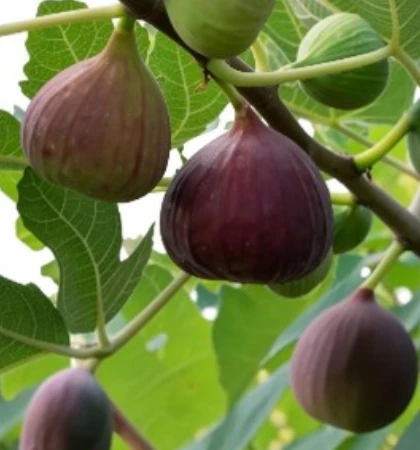
These contain high levels of soluble tannins. This means that you won’t want to eat these unless they’re fully ripe and completely softened. Whether eaten fresh or dried, astringent persimmons require a lot of patience before they can be consumed– but take it from us, they are well worth the wait! An astringent persimmon, when eaten ripe, will reward its consumer with deep, rich notes of brown sugar, maple syrup, and a hint of cinnamon. Astringent persimmons are often acorn or pumpkin shaped and will typically be vibrantly orange when ripe.
Experience Persimmons in your own garden by viewing our catalog HERE!
Let us know about your experience growing Persimmons! Reach out to us at: info@onegreenworld.com or leave a voicemail at (877) 353-4028